


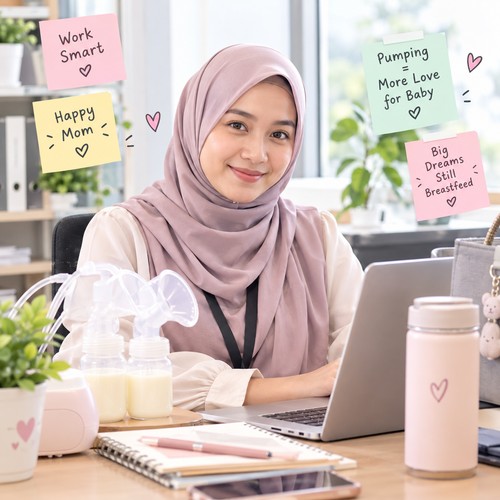
Breastfeeding Article for Working Mothers
“A Journey of Love, Patience, and Faith: A
Practical Guide to Successful Breastfeeding”
Giving birth is one of the most physically and
emotionally demanding experiences a woman can go through. During the postpartum
period, a mother's body undergoes significant hormonal changes while recovering
from childbirth. It is common to experience physical pain, birth trauma,
emotional instability, and moments of self-doubt. Many mothers describe this
phase as feeling as though they are no longer themselves.
If you are feeling this way, know that you are not
alone. These emotions are completely normal. The postpartum period is a major
life transition, and with time, support, and proper guidance, you will
gradually regain your confidence. Healing takes time, and so does learning to
care for your newborn.
For Muslim mothers, breastfeeding is not only a
natural way to nourish a child but also an act encouraged by Allah SWT. The
Qur'an provides guidance on breastfeeding and highlights its significance in
nurturing both the physical and emotional well-being of a child.
Allah SWT reminds us in Surah Al-Baqarah (2:233):
“Mothers may breastfeed their children for two
complete years for whoever wishes to complete the nursing period. The
father of the child shall bear the cost of the mother's food and clothing
according to what is reasonable. No person shall be burdened beyond his
capacity. No mother should be harmed because of her child, nor should a father
because of his child. The same duty rests upon the heir. If both parents
decide, by mutual consent and consultation, to wean the child earlier, there is
no blame on them. Likewise, if you decide to have your children nursed
by another woman, there is no blame upon you, provided you pay fairly what you
have agreed upon. And be mindful of Allah and know that Allah sees all that
you do.”
(Surah
Al-Baqarah, 2:233)
This beautiful verse reminds us that Islam encourages
breastfeeding for up to two complete years while also recognising the realities
faced by parents. The verse emphasises compassion, shared parental
responsibility, mutual consultation, and flexibility when circumstances require
different decisions. Breastfeeding should never become a source of harm or
unbearable hardship. Instead, it should be approached with wisdom, patience,
love, and reliance upon Allah SWT. While breastfeeding is a natural process, it
is also a learned skill. Like any meaningful journey, it requires preparation,
knowledge, perseverance, and continuous support.
----------------------------------------------------------------------------------------------------------------
1. Pregnancy:
Where the Breastfeeding Journey Begins
A successful breastfeeding journey begins long before
your baby is born.
During pregnancy, spend time reading about
breastfeeding. Learn about what happens during the first few days after
delivery, realistic expectations, newborn feeding behaviour, common
breastfeeding challenges, and ways to overcome them. The more informed you are
before giving birth, the more confident you will feel when your baby arrives.
If possible, attend antenatal or parenting classes
together with your husband. Breastfeeding is not solely a mother's
responsibility. A supportive and knowledgeable partner can provide
encouragement, practical assistance, and emotional reassurance throughout the
journey.
Maintaining good physical health throughout pregnancy
is equally important. A healthy pregnancy often contributes to a smoother
labour and fewer birth complications. Mothers who recover well after childbirth
generally find it easier to establish breastfeeding compared to those
recovering from severe birth trauma or medical complications.
Besides preparing physically and mentally, strengthen
your spiritual preparation as well. Make sincere prayer throughout your
pregnancy and ask Allah SWT to bless your breastfeeding journey with ease,
patience, strength, and abundant sustenance for your child. While knowledge,
planning, and professional support are essential, every breastfeeding journey
ultimately unfolds according to Allah's wisdom. Trust Allah while making every
reasonable effort.
One of the most valuable preparations you can make is
identifying a qualified Lactation Counsellor (LC) or Lactation Consultant who
provides home visits after delivery. Breastfeeding should begin correctly from
the very beginning. It should not be approached as a process of trial and
error. Unfortunately, many mothers only seek professional help after
encountering significant breastfeeding problems, when many of those issues
could have been prevented through early intervention.
Although nurses and hospital lactation staff provide
excellent support during your hospital stay, their role naturally ends once you
are discharged. The real breastfeeding journey begins at home. Having access to
a private lactation counsellor ensures that professional guidance continues
when you need it most.
Take time during pregnancy to research several
lactation counsellors. Read testimonials, compare the services they offer,
enquire about home visit packages, and communicate with them before your
expected delivery date. Inform them of your Estimated Due Date (EDD) so they
can be ready to assist you shortly after childbirth. Meanwhile, gradually
prepare the essential items for both mother and baby without feeling pressured
to buy everything at once.
If you plan to hire a confinement lady (CL), choose
someone who genuinely supports breastfeeding. As the client, you have every
right to expect this. Many mothers struggle with breastfeeding simply because
they receive advice that discourages direct breastfeeding or promotes
unnecessary formula supplementation.
One common misconception is purchasing a breast pump
before delivery. While there is no harm in researching different brands, it is
generally advisable not to purchase one immediately. Unless mother and baby are
expected to be separated due to medical reasons, a breast pump is usually
unnecessary during the early establishment of breastfeeding.
Do not be influenced by statements such as, "Buy
it now before the baby arrives, or you won't have time later." Today,
breast pumps can easily be purchased with same-day delivery if required.
However, what cannot be delivered instantly is the professional expertise of a
lactation counsellor. Investing in breastfeeding support is often far more
valuable than purchasing breastfeeding equipment too early.
----------------------------------------------------------------------------------------------------------------
2. The
Real Breastfeeding Journey Begins: The First Few Days at Home
Once you are discharged from the hospital and reunited
with your baby, arrange for your lactation counsellor to visit your home as
soon as possible. During the consultation, your counsellor will assess both
mother and baby. This includes checking for tongue-tie or other oral
restrictions, examining the mother's breasts, observing breastfeeding sessions,
and guiding you on proper positioning, attachment, and effective latching
techniques.
A typical home visit lasts between one and two hours.
During this time, your counsellor will provide personalised guidance tailored
to your individual situation and advise you on managing the critical first few
days after birth. Most counsellors also encourage mothers to remain in contact
whenever further assistance is needed.
It is important to understand the role of a lactation
counsellor. Their responsibility is to provide evidence-based knowledge,
practical breastfeeding techniques such as hand expression (Marmet technique),
emotional encouragement, and ongoing support.
However, the person who ultimately determines the
success of the breastfeeding journey is the mother herself.
Professional guidance can only show you the way. Your
commitment, patience, consistency, and willingness to continue through
difficult days are what determine long-term success.
A compassionate lactation counsellor should also be
someone who listens attentively, understands your struggles without judgement,
shows empathy during challenging moments, motivates you when you feel
discouraged, and reassures you that you are not alone. Sometimes, the greatest
support a new mother needs are simply someone who believes in her.
----------------------------------------------------------------------------------------------------------------
3. The
Confinement Period: Navigating the Early Challenges
The confinement period is often one of the most
physically and emotionally demanding phases of motherhood.
Your body is recovering from childbirth while your
hormones continue to fluctuate. You are learning how to breastfeed, caring for
a newborn who cries frequently, adjusting to sleep deprivation, and coping with
the many responsibilities of caring for a new family member.
Some days, you may feel emotionally overwhelmed. Your
home may seem untidy, family members may also feel stressed, and everything may
appear more difficult than expected.
This is completely normal.
Remain calm and continue breastfeeding with patience.
The first few weeks are often the hardest, but they are temporary. Every
successful feeding strengthens your milk supply, builds your confidence, and
deepens the bond between you and your baby.
There will be sleepless nights, moments of
frustration, and times when you question yourself. Yet remember the timeless
saying:
“When the going gets tough, the tough keep
going.”
Remember, every difficult day brings you one step
closer to establishing a successful breastfeeding routine.
----------------------------------------------------------------------------------------------------------------
4. Breastfeeding
Journey: Avoiding Common Pitfalls
One of the greatest threats to successful
breastfeeding today is emotional vulnerability combined with constant exposure
to social media.
After several exhausting postpartum days, it is
natural to search online for breastfeeding advice. However, your social media
feeds may quickly become filled with advertisements promoting breast pumps,
milk collectors, expensive accessories, milk booster, flange fitting services, and
products claiming to make breastfeeding easier.
Over time, this constant exposure can make you feel as
though successful breastfeeding depends on buying more equipment or following
every new trend.
When this happens, take a step back.
Step away from social media for a while. Protect your
mindset.
Give yourself a break from social media and do not let
the fear of missing out (FOMO) convince you that you need every product,
technique, or viral breastfeeding trend to succeed.
Whether it is flange fitting (FF), the pitcher method,
or other popular breastfeeding practices, remember that these are simply tools
or techniques that may be useful in certain situations, they are not the
foundation of successful breastfeeding.
Instead, focus on mastering the basics.
Build your confidence in direct breastfeeding by
learning proper positioning, achieving a good latch, recognising your baby's
feeding cues, and feeding responsively. Once these fundamentals are well
established, adapting to pumping or other breastfeeding methods will become
much easier when the need arises.
A strong foundation in direct breastfeeding is one of
the greatest investments you can make for a successful and sustainable
breastfeeding journey.
Most importantly, strengthen your heart through
prayer. Ask Allah SWT to bless you with patience, resilience, confidence, and
the strength to continue your breastfeeding journey. Place your trust in Allah
and remember that every sincere effort you make to nourish your child is an act
of love and devotion.
At the same time, prioritise your emotional
well-being. Caring for yourself is not a luxury; it is an essential part of
caring for your baby. Every mother deserves moments of rest, comfort, and
self-care while adjusting to the demands of motherhood. Take time to watch your
favourite movies, enjoy nutritious meals, listen to uplifting music, read a
good book, spend quality time with your loved ones, or even indulge in a little
online shopping if it helps you unwind. Remember, looking after your own mental
and emotional well-being is not selfish; it enables you to care for your baby
with greater patience, strength, and love.
Day by day, without even realising it, your
confinement period will come to an end. More importantly, your breastfeeding
journey will gradually become established!
----------------------------------------------------------------------------------------------------------------
5. Returning
to Work: The Next Chapter of Your Breastfeeding Journey
For most mothers, the ideal time to purchase a breast
pump is approximately one month before returning to work, whether your
maternity leave lasts 30 or 60 days.
Avoid believing the common advice that you must begin
pumping immediately after birth to build a large freezer stash. This often
creates unnecessary pressure during a period when your priority should be
establishing direct breastfeeding.
Remember that every child's sustenance has already
been decreed by Allah SWT. Breast milk is part of that beautiful provision.
Continue making sincere prayer, place your trust in Allah, and strive to
breastfeed to the best of your ability. While we are encouraged to make every
reasonable effort, the outcome ultimately belongs to Allah.
Before returning to work, arrange another consultation
with your lactation counsellor. They can help you develop an effective pumping
schedule, guide you on proper breast milk storage techniques, and prepare you
to balance breastfeeding with your professional responsibilities.
Remember that a breast pump is simply a tool.
Breast pump is not a replacement for breastfeeding.
Its primary purpose is to express milk when you and your baby are separated.
Whenever you are together, whether at home, during weekends, or while on leave,
prioritise direct breastfeeding whenever possible. This not only supports your
baby's nutritional and emotional needs but also helps maintain your milk supply
and strengthens the unique bond between you and your baby.
If you decide to purchase a breast pump, take the time
to explore different brands and flange sizes. Every mother's body is unique, so
there is no one-size-fits-all breast pump. The best breast pump is simply the
one that fits comfortably, expresses milk effectively, and suits your
individual needs and lifestyle.
----------------------------------------------------------------------------------------------------------------
6. Breastfeeding
Journey: A Final Reflection
Many mothers aspire to breastfeed their children for
the full two years, as encouraged in the Holy Qur'an. It is a beautiful goal
and a meaningful milestone, but looking too far ahead can sometimes feel
overwhelming, especially during the challenging early weeks of motherhood.
Instead of asking yourself whether you can breastfeed
for two years, ask yourself one simple question:
“Can I do this for one more day?”
One day at a time.
One feeding at a time.
One small victory at a time.
Those small daily efforts gradually become weeks, then
months, and before you realise it, they become a beautiful breastfeeding
journey that you can look back on with gratitude and pride.
Remember that success is not measured by perfection,
but by perseverance.
Some mothers may be able to breastfeed exclusively and
continue breastfeeding for up to two years, while others may face medical,
personal, or family circumstances beyond their control. Islam recognises that
every family's situation is unique and encourages parents to make decisions
with wisdom, mutual consultation, compassion, and the best interests of the
child at heart.
Above all, place your trust in Allah SWT, strive to
strengthen your knowledge and confidence in breastfeeding.
Seek beneficial knowledge, embrace the support of
those around you, remain patient through every challenge, and never
underestimate your own strength. With sincere effort, heartfelt prayer, and
complete reliance upon Allah SWT, may your breastfeeding journey become not
only a source of nourishment and comfort for your child but also a beautiful
act of worship that earns Allah pleasure and blessings.
Remember, success is not about holding on for 2 years.
It is not about holding on for 1 year.
It is not about holding on for 6 months.
It is not even about holding on for 30 days.
Success begins by holding on for just one more day!
Happy World Breastfeeding Week 2027!
“Breastfeeding for a Sustainable Start in Life:
Strengthen What Works.”
Original concept/idea by: Jenidawaty
Written by: Umi Shakila